
Madlener House
4 West Burton Place
Chicago, Illinois 60610
Telephone: 312.787.4071
info@grahamfoundation.org
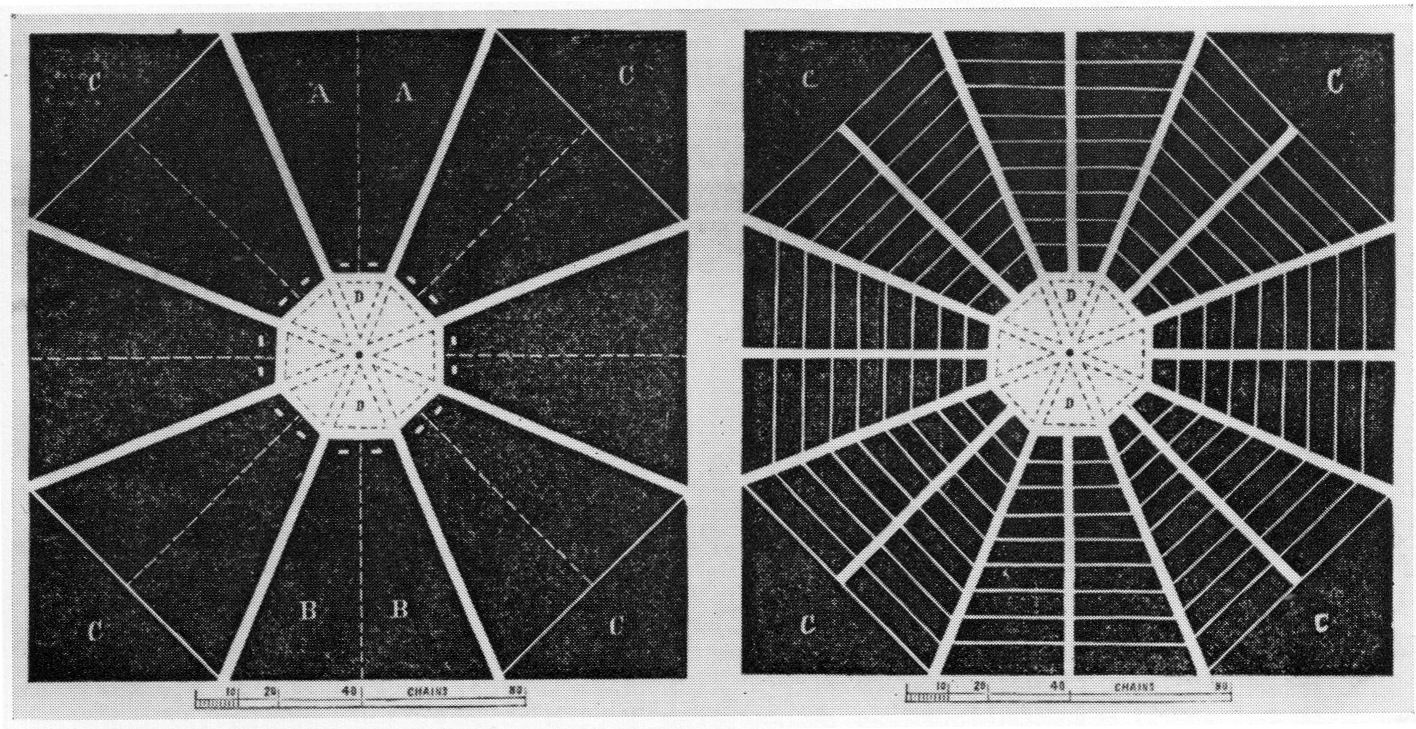
Projected plans of an octagon vegetarian abolitionist colony in Kansas, from the American Phrenological Journal 22 (1856)
Irene Cheng, Columbia University, Graduate School of Architecture, Planning, and Preservation, is the recipient of the 2010 Carter Manny Research Award.
In the first half of the nineteenth century, designers and reformers in the United States embraced the radical idea that architecture could not only to represent its inhabitants but also mold their bodies and minds. This faith in the transformative power of the physical environment converged with a fascination for distinct architectural geometries, giving rise to a wave of octagon buildings in the years between 1790 and 1860. Irene Cheng's dissertation, The Shape of Utopia: Architectures of Radical Reform in Nineteenth-Century America, links eight-sided buildings--structures frequently dismissed in older histories as 'fads' or 'follies'--with antebellum radical reform movements such as phrenology, water cure, vegetarianism, and sexual reform. Cheng argues that numerous Americans, from Thomas Jefferson to Orson Fowler, saw octagon architecture as a tool to cultivate new kinds of private 'selves'--stronger, healthier, more rational subjectivities capable of negotiating an emergent capitalist and democratic society.
Irene Cheng is a PhD candidate in architecture history and theory at Columbia University. Her research focuses on nineteenth-century American architecture and culture, with an emphasis on utopian movements, the history of science, and radical politics. She holds an M.Arch. from Columbia and a B.A. in Social Studies from Harvard University. Cheng is also a founding partner of Cheng + Snyder, a multidisciplinary design firm based in New York City.
Copyright © 2008–2026 Graham Foundation. All rights reserved.