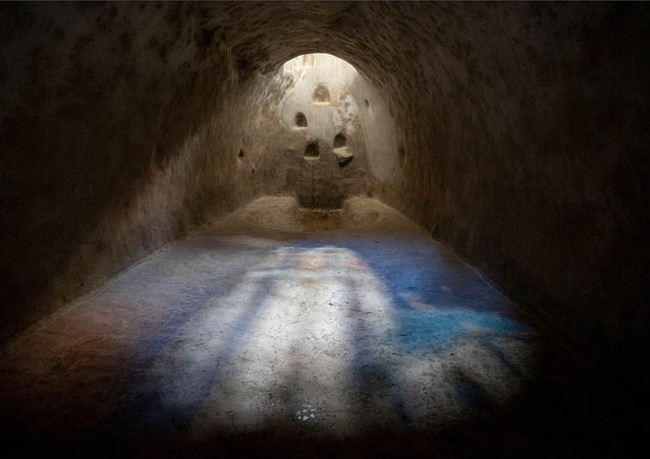
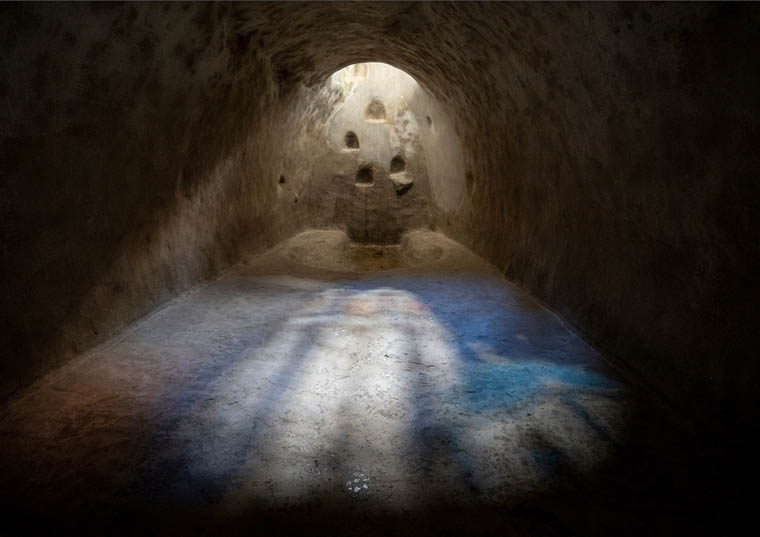
Boulouki, Y. Kyvernitis, “Repaired interior of underground cistern,” Agrilia, 2021. Digital photograph. Courtesy Boulouki Archive, Athens
Landscapes have long been caught between aesthetic spectacles and resources for extraction. This volume challenges this dichotomy by approaching landscapes as sites where different ways of knowing and being in the world intersect. Organized in three parts—dwellings, encounters, grounds—and framed by a prologue from Karsten Harries and an epilogue from Tim Ingold, the book brings together humanities, spatial ,and environmental disciplines to explore diverse contexts, ranging from Chinese maps and folktales to Dutch paintings and American films, and from mythicized Greek peripheries to Incan farming practices. The volume emerged from the symposium “Under the Landscape” (2022), part of a broader initiative organized by the Boulouki collective on the volcanic islands of Santorini and Therasia, Greece. This initiative combined craft training, artistic residencies, and collaborative research—documented in photo essays between the book's sections. Together, the essays and this broader initiative demonstrate how place-based practices foster alliances between craft and scholarship, artistic practice and scientific research, human communities and more-than-human life—alliances that unsettle extractivist paradigms and open pathways toward more just and sustainable worlds.
Ionas Sklavounos is an architect and cofounder of the crafts collective Boulouki. He received his PhD form the University of Antwerp, supported by the Marie Curie Doctoral Network “TACK – Communities of Tacit Knowledge: Architecture and Its Ways of Knowing.” His research interests span architectural theory, studies of craftsmanship, and partnerships across diverse knowledge systems. Sklavounos has been a visiting researcher at the Architekturzentrum Wien (AzW) in Austria, and actively involved in the organization of academic gatherings, hands-on workshops, and projects of participatory restoration of cultural landscapes with Boulouki.
Marilena Mela is assistant professor in heritage studies in the Faculty of Humanities of Vrije Universiteit Amsterdam. Her PhD project was funded by the European project HERILAND on the relationship of cultural heritage and spatial planning in Europe. Her research investigates the nexus between heritage, sustainability, and climate with a focus on island landscapes. Mela teaches courses on heritage, landscape, and the city at undergraduate and graduate levels and is a collaborator of the collective Boulouki.
Faidon Moudopoulos-Athanasiou is a Juan de la Cierva postdoctoral fellow at the Landscape Archaeology Research Group, Catalan Institute of Classical Archaeology. Moudopoulos-Athanasiou holds a PhD in archaeology from the University of Sheffield, where he investigated the archaeological landscape of early modern Zagori (northwest Greece). At that time, he was a scholar of the White Rose College of the Arts and Humanities (AHRC) and of the A.G. Leventis Foundation. His research interests include, but are not limited to, archaeological ethnography, Mediterranean archaeology, and landscape archaeology with a particular interest on the Ottoman period.
Nikos Magouliotis is an architectural historian and postdoctoral researcher at ETH Zurich/gta, studying with professor Dr. Maarten Delbeke, where he teaches courses related to early-modern history and theory of architecture. His research focuses on the history and historiography of architecture in the eighteenth and nineteenth centuries with a particular focus on the vernacular, both as a theoretical construct and as a historical reality. Magouliotis has published articles and papers in magazines such as San Rocco, ARCH+, and Cartha, as well as academic journals including Architectural Histories, Future Anterior, The Journal of Architecture, and Architecture Beyond Europe.
Karsten Harries is professor emeritus of philosophy at Yale University. He is a thinker in the fields of modern philosophy, and theory of art and architecture. Among his work, The Ethical Function of Architecture (MIT Press, 1998) traces the historical transformations of ideas around the cultural role of architecture and art, throughout modernity. His view on the tension between the “ethical” and the “aesthetic” understanding of this role is proposed to be seen as a key concept to approach the complex theme of the landscape.
Tim Ingold is professor emeritus of social anthropology at the University of Aberdeen. His pioneering approach to material culture, through the overlaps of archaeology and anthropology, architecture and art, has made him one of the most prominent voices internationally around the studies of “making.” In his work, issues of embodied perception and skilled practice are explored within both social and environmental contexts, yielding a situated and relational understanding of the (more-than-human) world. At the same time, his studies specifically around the question of landscape have been highly influential, receiving international and interdisciplinary acknowledgement.
Kenneth Olwig is professor emeritus of landscape planning at the Swedish University of Agricultural Sciences. He studies the concept of landscape in different cultural contexts, and its relationships with justice and governance. In his seminal article, “Recovering the Substantive Nature of Landscape” (1996) he advocates for a “substantive” landscape, which comes in contrast with the “apparent” one. This, and other influential essays, are included in the published collection The Meanings of Landscape: Essays on Place, Space, Environment, and Justice (Routledge, 2019).
Boulouki Itinerant Workshop is a versatile collective of architects, engineers, and heritage professionals, dedicated to revitalizing traditional craftsmanship for contemporary construction needs. Encompassing hands-on education, sustainable architecture, and (cultural) landscape management, Boulouki was established in 2018 and operates as a nonprofit organization based in Athens. In Greek, boulouki means “gaggle,” traveling group, a name evoking the tradition of traveling companies of stone masons and craftsmen. Boulouki’s vision is to promote a renewed building culture in Greece and worldwide, drawing from traditional knowledge and techniques, towards truly sustainable building. The collective engages in hands-on training and work, constructing meaningful projects for communities in genuine need. Each project becomes an opportunity to seek out and revive traditional forms of knowledge, by bringing together seasoned craftspeople, local residents, and a global network of committed researchers and practitioners from diverse backgrounds and disciplines.