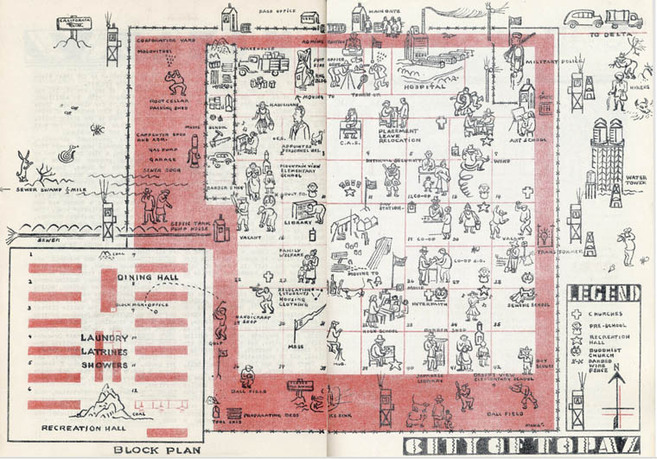
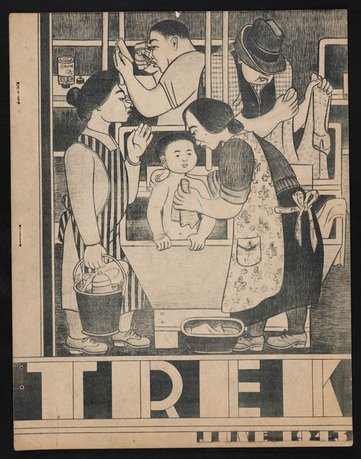
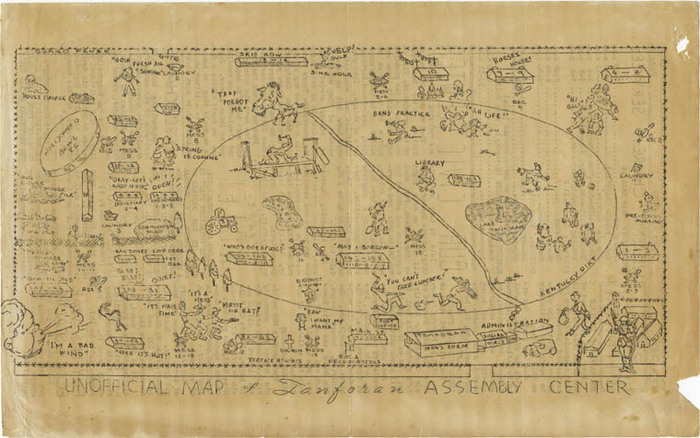
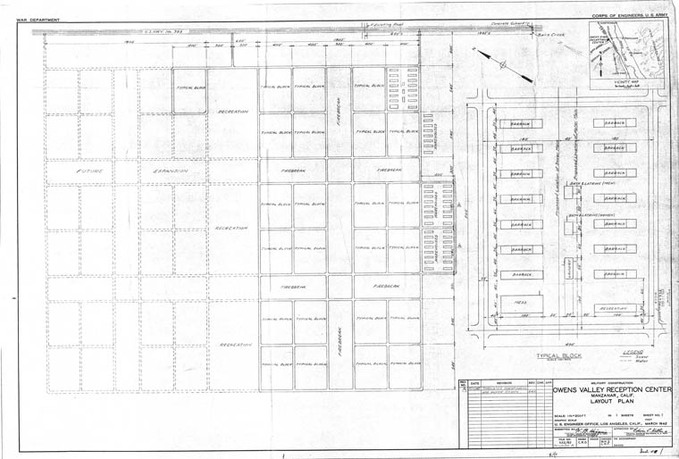
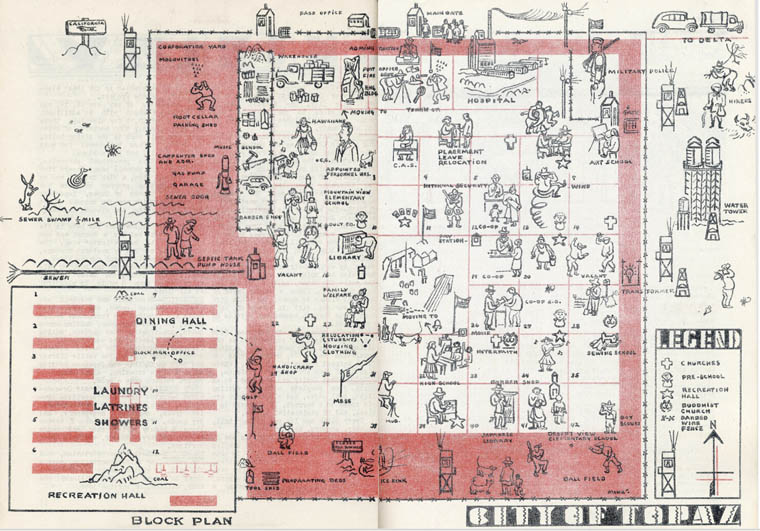
Central Utah Relocation Center, “Mine Okubo’s centerfold spread ‘The City of Topaz,’” from “Trek,” volume 1, number 3, Delta, Utah: Projects report Division of the Central Utah Relocation Center, June 1943. Double page mimeograph spread, 11 x 17 in. Courtesy Chiura Obata papers, 1891—2000, Archives of American Art, Smithsonian Institution
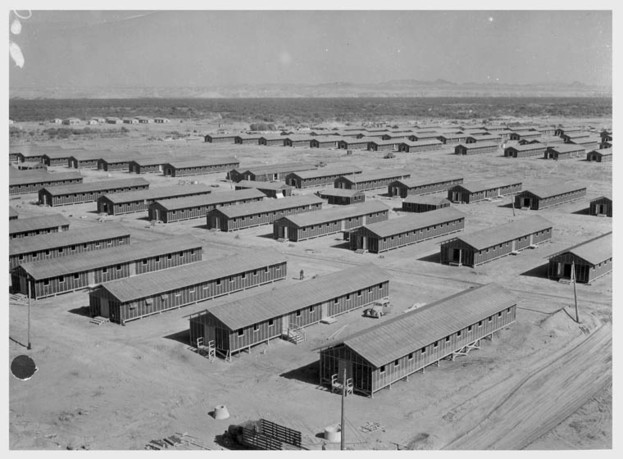
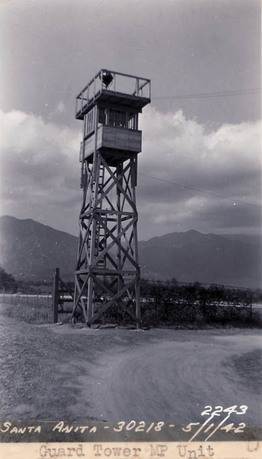
Dislocations: The Architecture, Planning and Building of Prison Cities for Japanese and Japanese Americans during World War II is a comprehensive history of the planning, design, and construction of the confinement of “people of Japanese ancestry” first in temporary detainment camps and then in semi-permanent concentration camps. They were held under armed guard for an unspecified amount of time, suspected of espionage and sabotage but without any substantial charge. With an introduction of its historical context, following chapters explore the professional ethics of the building of the prison cities and the scale and substance of the government production of these prison cities. The volume also explores the prisoners' community building, material culture, and journeys through carceral environments. It is a history of the material world of these prison cities that draws from government archival material, oral histories, biographies, and the extensive historiography and internet resources on the incarceration.
Lynne Horiuchi is an independent scholar who received her PhD in 2005 at the University of California, Santa Barbara. She has published numerous articles on the built environments of Japanese American incarceration. Race, space, architecture, and ethics are her theoretical interests crossing over into Asian American studies, art history, vernacular architecture, and urban planning. She has coedited with Tanu Sankalia Urban Reinventions: San Francisco’s Treasure Island (University of Hawai’i Press, 2020); and cowrote with Anoma Pieris, The Architecture of Confinement: Incarceration Camps of the Pacific War (Cambridge University Press, 2022). She has taught at the University of North Carolina, Charlotte, and in the Department of City and Regional Planning at the University of California, Berkeley. She was named a Society of Architectural Historians Fellow in 2021. She has been awarded grants from the National Endowment for the Humanities, the Huntington Library, and MacDowell.