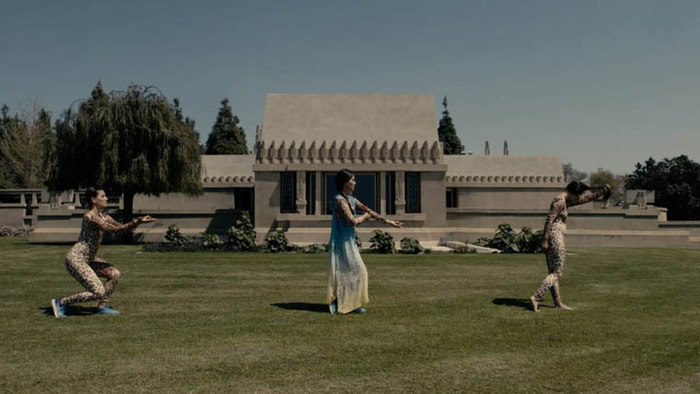
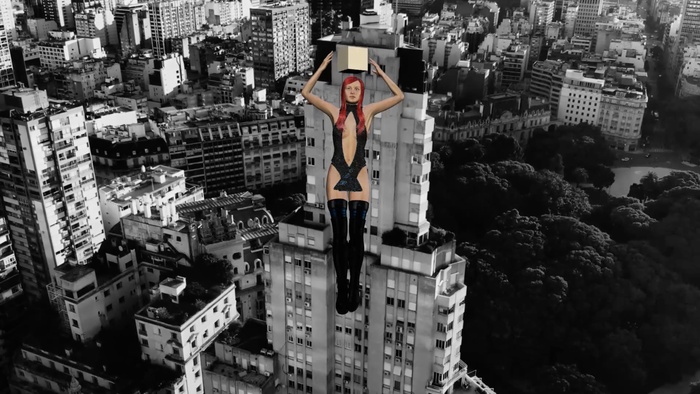
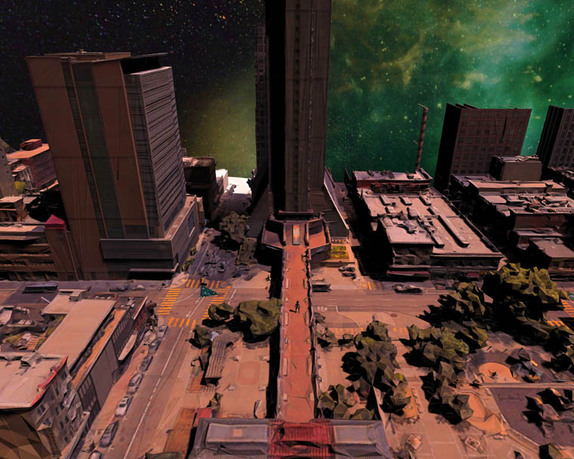
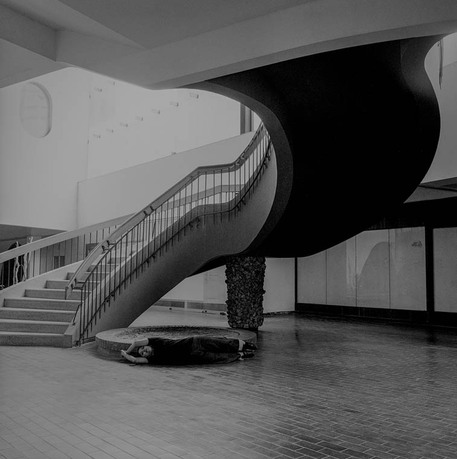
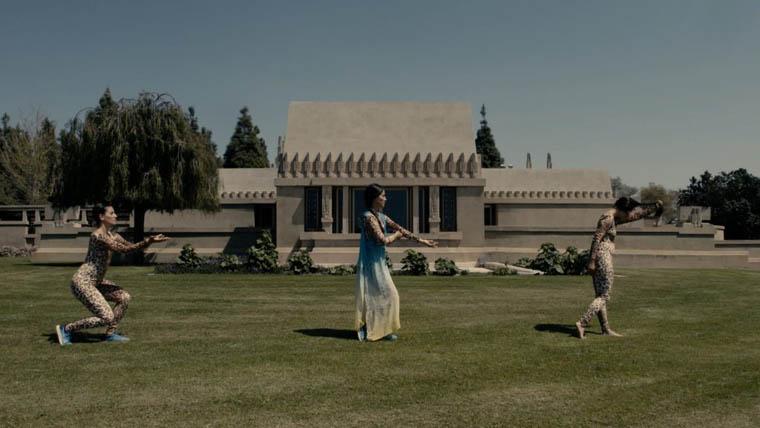
Clarissa Tossin, “Chu Mayaa,” 2017. Digital video, stereo sound, 17:56 min. Courtesy Clarissa Tossin and Smith College Museum of Art
Taking its title from American choreographer Trisha Brown’s two-minute film Man Walking Down the Side of a Building (1970), this exhibition showcases multimedia works by emerging and established international women artists who subvert a male-dominated history of Modernist architecture and urbanism, creating new narratives and activating the built environment through movement, dance, ritual, and performance art. Woman Dancing Down the Side of a Building focuses on two interconnected themes: “City-Woman-City,” inspired by the influential 1978 work by pioneer video artist Pola Weiss, a commentary on surviving the urban landscape as a woman, and “Architectural Hauntings,” with works exploring architecture as ruin in relation to dance and choreography and counterposing the body against twentieth century architectural experimentation.
Fabiana Barreda is a photographer and performance artist, curator, and art critic; she teaches Psychology of Art at the National University of Tres de Febrero and Contemporary Art at the University Institute of Art. She has received the Young Art Biennial Award, Photographer of the Year Award (AACA), Klemm Foundation Photography Award, National Arts Fund Award, Konex Foundation Visual Arts Award, Third Mention at the National Photography Salon, and the Chandon BAPhoto Award. She has received grants from the Antorchas Foundation, the National Fund, and the Salzburg Scholarship (Austria). She has participated in the Havana Biennial (Cuba), the Rotterdam Architecture Biennial (Netherlands), and the End of the World Biennial in Ushuaia, Argentina. Her works are in the collections of the MALBA Museum, The Museum of Modern Art, and the Castagnino Museum in Rosario, among other private and public collections.
Crystal Z Campbell, 2021 Guggenheim Fellow in fine arts, is a visual artist, experimental filmmaker, and writer of Black, Filipinx, and Chinese descents whose works center the underloved. Working through archives and omissions, Campbell finds complexity in public secrets—fragments of information known by many but undertold or unspoken. Campbell’s recent works use underloved archival material to consider historical gaps in the narrative of the 1921 Tulsa Race Massacre, revisit questions of immortality and medical ethics with Henrietta Lacks' “immortal” cell line, ponder the role of a political monument and displacement in a Swedish coastal landscape, salvage a 35mm film from a demolished Black activist theater in Brooklyn as a relic of gentrification, or reference traces of United States colonialism in the Philippines. Campbell is a visiting associate professor in art and media study at the University at Buffalo who lives and works between Oklahoma and New York.
Kiyo Gutiérrez is a Mexican multidisciplinary artist. Trained in history, she turned to performance to explore the body’s potential as a tool of resistance. Her work emerged as a response to Mexico’s brutal realities, femicide, disappearances, and environmental devastation. Her ritual-performances often integrate archival research, sculpture, textile, sound and audience participation. Her work reexamines the construction of colonial history, uncovering how bodies and materials themselves bear the traces of extraction, exploitation, resistance and transformation. Kiyo performs in public spaces and has participated in Performance Festivals and exhibitions in México, Brasil, Colombia, Bolivia, Spain, Italy and the United States. She participated in Irrational Exhibits 13 and is an alum of Georgetown University’s Laboratory for Global Performance and Politics. Kiyo is a recipient of the Franklin Furnace Fund, the Macomber Travel Grant, the Fulbright Scholarship, and was nominated for the Gilder/Coigney International Theatre Award. She received her MFA in Fine Arts at the Roski School of Arts of the University of Southern California..
Huntrezz Janos is a Black trans woman, Afro-Hungarian Angeleno, who is a transmedia artist/engineer working across XR, sculpture, architecture, performance, spoken word, biomechanical augmentation, installations, social practice, and animation. Her work transmutes ancestral memory through speculative tech and embodied ritual, summoning Black trans futures beyond extraction. Rooted in afroFuturist ecology, mutual aid, and queer liberation, she crafts autonomous worlds bridging digital/physical realms through post-human methodologies and decolonial praxis. From her self-built off-grid solar studio in LA, she practices regenerative creation for collective survival, mentoring emerging artists. She has shown works at The Museum of Modern Art, the Los Angeles County Museum of Art, Tate, Transfer, and the Athens Biennale. She conjures portals of refusal—insurgent joy weaving resistance, care, and mythic possibility into radical becoming.
Tamara Jones is an arts worker based in Tkaron:to (Toronto) and Yelamu (San Francisco). They create work about bureaucracy and urban choreography, often expressed through performance, appropriated media, experimental video, and participatory art practices. Jones’s work has been programmed by the Black Experimental Film Festival, Artspace Gallery, Pleasure Dome, Dancemakers, Images Festival, and Whippersnapper Gallery. Their writing—documenting art and social action in the cultural sector—has been published by The Local, Spring Magazine, Mayworks Festival, The Globe and Mail, The Ex-Puritan, and elsewhere.
Tarrah Krajnak is an artist working across photography, performance, and poetry. Krajnak is currently based in Los Angeles. She is an associate professor of art at University of California, Los Angeles, and is represented by Zander Galerie (Cologne/Paris). Krajnak is a 2024 Guggenheim Fellow and recipient of the Jury Prize of the Louis Roederer Discovery Award at Les Rencontres d’Arles; the Dorothea Lange-Paul Taylor Prize from the Center for Documentary Studies; the Hariban Grand Prize, from Benrido, Kyoto, Japan; and The Lewis Baltz Research Award from Le Bal, Paris. Krajnak has published three books including El Jardín De Senderos Que Se Bifurcan (DAIS, 2021); Master Rituals II: Weston’s Nudes (TBW, 2022); and RePose (FW Books, 2023). Krajnak’s work appears in the collections of The Museum of Modern Art (New York); Tate Modern (London); Victoria & Albert Museum (London); Centre Pompidou (Paris); and the Museum of Contemporary Photography (Chicago), among others.
Heesoo Kwon is a multimedia artist born in South Korea and based in San Francisco and Los Angeles. Her practice engages socio-ritualistic, autoethnographic, and archival methods to explore feminist technologies and speculative mythologies. Working with 3-D animation, modeling, and AI as generative tools, Kwon constructs heterotopic hyperspaces where time and memory are abstracted, enabling a rewriting of mythic matrilineal histories, a queering of familial relations, and the envisioning of decentralized communities and memoryscapes. These explorations are most notably embodied in her self-referential feminist religion, Leymusoom, and the Leymusoom Firefly series, which draws on AI-augmented family photographs from her childhood. Within these constructed realms, Kwon transcends inherited legacies of sacrifice, trauma, and patriarchal violence to propose transformative modes of existence, liberation, and kinship. Her work is held in the permanent collections of KADIST, Cantor Arts Center at Stanford University, and Huis Marseille, Museum for Photography.
jas lin (林思穎) is a queer Taiwanese American performance artist, choreographer, and movement facilitator whose work lives between experimental, art, commercial, and everyday worlds. Lin stages exorcisms and tantrums for purging choreographies of the learned body and shutting down internal and external surveillance cameras that suggest there is a proper way to move through the world. Their practice of deep feeling is invested in remembering what the body has been manipulated into forgetting. They value performance as a ritual of deep presence—by returning to our senses, we can reawaken to our possibility, connection, and agency within the world around us. Lin’s practice emerges from a vast lineage of teachers, from friendships to films to flowers. Centering play in the everyday, they experiment with multiplicity and contradiction while dancing with the world as their body.
Jillian Mayer is an artist and filmmaker. Through videos, sculptures, online experiences, photography, performances, and installations, Mayer explores how technology affects our lives, bodies, and identities by processing how our physical world and bodies are impacted and reshaped by our participation in a digital landscape. Mayer investigates the points of tension between our online and physical worlds, making work that attempts to inhabit the increasingly porous boundary between the two. Modeling how to subvert capital-driven modes of technological innovation is a consistent motif within her artwork. She is a recipient of the Creative Capital Fellowship, South Florida Cultural Consortium Visual/Media Artists Fellowship, Cintas Foundation Fellowship for Cuban Artists, and was named one of the “25 New Faces of Independent Film” by Filmmaker Magazine. She is a fellow of the Sundance Institute's New Frontiers Lab and New Narratives on Climate Change Lab.
Miranda (Mir) Morales Rosales is a visual artist, animator, and designer born in Mexico City and grew up between Estado de Mexico and Mexico City. She is a Fulbright COMEXUS scholar studying experimental animation MFA candidate at California Institute of the Arts through the sponsorship of Fulbright COMEXUS. Morales Rosales participated in academic exchange with the University of California, San Diego, visual arts department during her BFA. She was an author at Rookie Magazine for three years and has collaborated in diverse publications since then like Marvin Magazine, Invisible Wall/Muro Invisible by Desert Island x Dolor Local, “Perrita Digital Beibicreisi,” among others. In 2022 Rosales published “Ambrita”, a risograph zine about neurodivergence and borders with Beibi Creisi Press, an independent female + gender dissident publication from Mexico City. Her practice discusses contradictions through a gender and critical race theory perspective by the agency of moving images and drawings.
Born and raised in Japan and a resident of New York since 1976, Eiko Otake is a movement-based, interdisciplinary artist. From 1972–2013, she worked exclusively as Eiko & Koma, performing their own choreography and earning awards from MacArthur, United States Artists, American Dance Festival, Dance Magazine, and the inaugural Doris Duke Artist Award. Since 2014, Otake has directed her own projects. A series of site-specific solo works, A Body in Places, became the subject of her 2016 Danspace Platform, earning her a Bessie Award special citation, an Art Matters award, and an Anonymous Was A Woman award. In Duet Project (2017–), Otake collaborates with Ishmael Houston-Jones, Joan Jonas, DonChristian Jones, Iris McCloughan, Beverly McIver, and Mérian Soto. Wen Hui and Otake cocreated a film, No Rule Is Our Rule, and a performance work, What Is War, which premiered at Walker Art Center and toured to BAM’s Next Wave Festival.
Nancy Popp is a Los Angeles–born and based artist, educator, and organizer. Her work draws upon the rich traditions of durational, corporeal performance and direct political intervention to explore relations between the body as a site, the context of that site which envelops the body, and the constant fluctuations that connect the two. Her practice engages both architectural and public space to wrestle with the political and social boundaries of geography and identity through risky, playful, endurance-based and site-specific interventions and installations. She also works with photography, video, drawing, and community networking and organizing. She holds degrees from ArtCenter College of Design and San Francisco Art Institute and is represented by Klowden Mann Gallery, Los Angeles. She also writes for various magazines and websites on art, education, and politics.
Clarissa Tossin combines sculpture, installation, video, performance, tapestry, and collaborative processes to address hidden narratives embedded in the built environment and in global flows of production and circulation. Through an investigative approach, her work examines the materiality of culture and the ways in which symbolic and economic exchanges shape identities, territories, and imaginaries—both locally and globally. Raised in Brasília, Tossin developed an early interest in the implicit histories of architecture and urban planning, especially those that silence colonial violence or project myths of progress. Her work seeks to recontextualize these narratives by activating strategies of listening, displacement, and decolonization rooted in her own experience of migration. The artist thus proposes sensitive ways of questioning dominant structures and creating space for singular, often marginalized subjectivities.
Nicole Ucedo is a moving image artist working with digital and analog film, as well as textiles and plants. She is part of the Echo Park Film Center Collective, where she teaches filmmaking and programs community screenings. Her films have been shown in festivals, microcinemas and garage spaces around town. She lives and works in her beloved hometown of Los Angeles on occupied Tongva lands.
Selene Preciado is the curator and director of programs at LACE. Preciado has also worked at Getty Foundation, Museum of Contemporary Art (MOCA), Museum of Latin American Art (MOLAA), Centro Cultural Tijuana (CECUT), San Diego Museum of Art, and inSite_05. Recent curatorial projects include A Tender Excavation (2025–26) presented by LACE at the Luckman Gallery, California State University, Los Angeles; the performance series ENDURANCE (2025) and ABUNDANCE (2024, cocurated with Azul Silverio) presented by LACE at L.A. Dance Project; and Collidoscope: De la Torre Brothers Retro-Perspective, at The Cheech Marin Center for Chicano Art and Culture, organized with the National Museum of the American Latino (2022–23, ongoing national tour through 2026). Raised in Tijuana, Preciado obtained a Bachelor of Art in visual arts from the University of California, San Diego, and holds an Master of Art in art and curatorial practices in the public sphere from the University of Southern California.
Los Angeles Contemporary Exhibitions (LACE) both champions and challenges the art of our time by fostering artists who innovate, explore, and risk. LACE moves within and beyond the four walls of the organization to provide opportunities for diverse publics to engage deeply with contemporary art. In doing so, LACE furthers dialogue and participation between and among artists and those audiences. Founded in 1978, LACE is an internationally recognized pioneer among art institutions. Uniquely positioned among commercial galleries and major art establishments, our nonprofit organization provides a local venue that advocates and exhibits innovations in artmaking. LACE has nurtured generations of artists and has been the platform to develop newly emerging art forms such as performance art, video art, digital art, and installation-based work