GROUND TRUTHINGS: Local Soil Tasting + 2 Deep Maps
Nance Klehm
Oct 30, 2019
(6pm)
Workshop
SOLD OUT
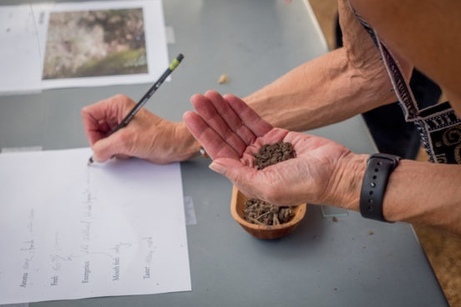
The practice of eating earth or soil-like substrates such as clay or chalk has a deep anthropological history and is practiced by various cultures around the world. For this program Klehm has collected soil from various locations around Chicago and her team will guide participants through a tasting to sensorially explore the minerals and biological processes that cause the different ‘notes’ and flavors of soil.
As part of the ongoing exhibition, Klehm and her collaborator and colleague Jacob Blecher will present their Deep Maps of two earthen sites in Chicago: Madlener House (Gold Coast) and Raber House (Englewood) will be presented along with soil corings on trays made from local clay Klehm has dug and processed.
Nance Klehm is internationally respected for her work on land politics and soil health. Her work has received extensive national and international media coverage amongst those: Time Magazine, BBC Canada, MSN, Los Angeles Times, Philadelphia Inquirer and is mentioned in many books, including Leila Darwish’s Earth Repair (2013), Sandor Katz’s The Revolution Will Not Be Microwaved (2006) and Alexandra Toland's Field to Palette: Dialogues on Soil and Art in the Anthropocene (2019). She won the 2010 Utne Visionary Prize and is a member of the Curry-Stone Design Prize Social Design Circle. In addition, she has lectured broadly in museum and university settings as well as for countless community groups worldwide. Klehm is the author of: The Ground Rules: a manual to reconnect soil and soul (2016) and The Soil Keepers: Interviews with practitioners on the ground beneath our feet (2019) and is working on a manual on microbial remediation of contaminated soils. Most recently, she was the subject of the independent documentary, Weedeater. Nance splits her time between La Villita, a densely packed, urban neighborhood in Chicago and her 50 acres of land in The Driftless Region. http://www.socialecologies.net
Jacob Blecher is a writer, grower, and horticulturalist based in Wilmington, NC. With Social Ecologies, he helped develop a city-wide community composting and bioremediation project in Chicago called The Ground Rules. He holds a BA from Yale University and an MA in Political Science from the University of Chicago.
Image: Nance Klehm, documentation from Hyperobjects – Mineral
Free Exposure Soil Tasting with artist and ecologist Nance Klehm at Capri in Marfa, Texas, August 24, 2018. Courtesy Ballroom Marfa. Photo: Rowdy Lee Dugan
For more information on the exhibition, Tatiana Bilbao Estudio: Unraveling Modern Living, click here.

Re-root + Redux at The Commons
Sweet Water Foundation
Oct 23, 2019
(1pm)
Workshop
Space is limited, please complete this form to express interest in participating:
Hosted by Sweet Water Foundation at The Commons, 5749 S Perry Avenue, Chicago IL
Sweet Water Foundation is excited to welcome participants at its flagship site, The Commons, for a two-hour tour and hands-on experience on Wednesday, October 23. During the workshop, participants will be challenged to explore their relationship with the world around them, integrate Sweet Water Foundation’s practice of Regenerative Neighborhood Development in their lives, and consider the relationship between places where one lives, where things grow, and where things are built or torn down. Participants will engage in hands-on activities such as farming/gardening techniques, carpentry, and printmaking.
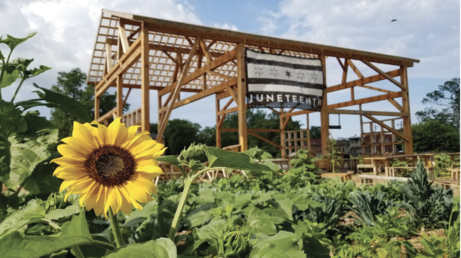
Sweet Water Foundation practices regenerative neighborhood development, a creative social justice method, that creates safe and inspiring spaces by establishing healthy, intergenerational communities that transform the ecology of once-“blighted” neighborhoods. The Foundation utilizes a blend of urban agriculture, art, and education to transform vacant spaces and abandoned buildings into economically and ecologically productive and sustainable community assets that produce engaged youth, skilled workers, art, locally-grown food, and affordable housing. These principles are realized in the flagship Foundation project, the Perry Avenue Commons, encompassing approximately three acres on the South Side of Chicago.
Image: The Thought Barn at The Commons, Sweet Water Foundation
For more information on the exhibition, Tatiana Bilbao Estudio: Unraveling Modern Living, click here.
La Ricarda: An Architectural and Cultural Project
Marita Gomis with MAS Context
Oct 14, 2019
(6pm)
Talk
Please RSVP
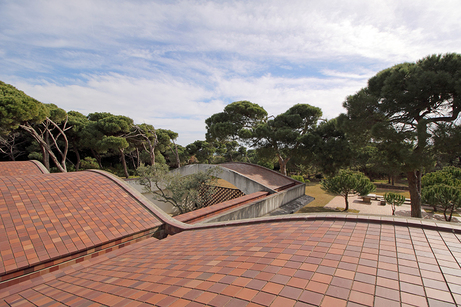
La Ricarda or Casa Gomis, completed in 1963, is one of the key midcentury buildings in Spain. Barcelona-born architect Antonio Bonet Castellana, who trained with Le Corbusier and Josep Lluís Sert, designed the house while living in Buenos Aires. Working closely with the clients, Ricardo Gomis and Inés Bertrand via letters, Bonet designed every aspect of the building, from the overall organization to the materials, interior details, and furniture. Besides its architectural merit, the house is also remarkable for the critical cultural role it has played in Catalonia, particularly during Franco’s dictatorship, when the Gomis Bertrand family supported and welcomed artists and intellectuals such as John Cage, Merce Cunningham, Josep Mestres Quadreny, Carles Santos, Joan Prats, Robert Gerhard, Villèlia, Antoni Tàpies, Joan Miró and Joan Brossa, transforming it into a haven for artistic experimentation.
Having grown up in Casa Gomis, Marita Gomis discusses the design and construction of the iconic house, the cultural activities it hosted, its relevance more than five decades after it was built, and the efforts and challenges to preserve it.
This talk accompanies the exhibition La Ricarda: An Architectural and Cultural Project organized by MAS Context, on view October 12, October 19, and October 26, 2019 at Lawrence & Clark.
This event is a partner program of the 2019 Chicago Architecture Biennial.
Marita Gomis, along with her five siblings, is the owner of Casa Gomis, one of the key midcentury buildings in Spain and the house she grew up in. Commissioned by Ricardo Gomis and Inés Bertrand, it was designed by Antonio Bonet Castellana and completed in 1963. A haven for artistic experimentation, the house hosted many cultural activities and continues to be a must-see destination for architecture students and professionals from around the world. Marita and the rest of the Gomis Bertrand family has diligently preserved it in its original state with the help of local architects Fernando Álvarez and Jordi Roig.
MAS Context is nonprofit a quarterly journal created by MAS Studio in Chicago that addresses concerns that affect the urban context. Each issue delivers a comprehensive view of a single topic through the active participation of people from different fields and perspectives who, together, instigate the debate.
Lawrence & Clark is a collection-based gallery run by Jason Pickleman. The collection spans more than 1000 works in all media. The storefront gallery is an opportunity to exhibit privately held artwork in a public setting. The gallery is open every Saturday from 1 p.m. until 5 p.m. and by appointment. For more information, please visit: lawrenceandclark.com.
Image: Casa Gomis, El Prat de Llobregat, 2019. © Iker Gil.
For more information on the exhibition, Tatiana Bilbao Estudio: Unraveling Modern Living, click here.
Tatiana Bilbao Estudio, from Unraveling Modern Living, digital collage, 2019
Tatiana Bilbao Estudio: Unraveling Modern Living Opening Reception
Sep 16, 2019
(6pm)
Opening Reception
Please RSVP
Join us for a reception with Tatiana Bilbao Estudio to celebrate the opening of the new exhibition Unraveling Modern Living.
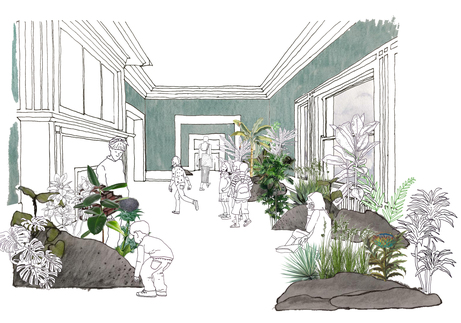
Mexico City-based architecture office Tatiana Bilbao Estudio creates an immersive installation that transforms a former domestic space to explore new forms of collectivity. The installation is activated by collaborative projects, on-site talks, and workshops throughout the run of the exhibition with Archeworks, Colectivo 1050º, Cultural ReProducers, Fieldwork Collaborative Projects, Stefan Gruber, Nance Klehm of Social Ecologies, Lurie Garden, MAS Context, Midewin National Tallgrass Prairie, Sweet Water Foundation, The Weaving Mill, and Anna Martine Whitehead, among others.
Tatiana Bilbao founded her Mexico City-based eponymous architecture studio in 2004. Her work analyzes site specificity and creates built environments through multidisciplinary and cross-cultural perspectives. She has taught as a visiting professor at the Yale School of Architecture, Harvard Graduate School of Design and Columbia University Graduate School of Architecture, Planning and Preservation. Bilbao’s work has been published in Architecture + Urbanism, GA Houses, Domus, and The New York Times, among other outlets.
Tatiana Bilbao Estudio creates work internationally at various scales, translating vernacular social codes into architecture, to develop affordable and sustainable architectural practices. Highlighted projects in Mexico include: the Culiacán Botanical Garden; the Pilgrim Route, Jalisco; and the Biotechnological Center, Sinaloa. In 2015 the studio built the Sustainable House, a social housing prototype displayed at the Chicago Architectural Biennial. The work has been recognized widely with awards such as the Berlin Art Prize and the Global Award for Sustainable Architecture.
This exhibition is presented in partnership with the 2019 Chicago Architecture Biennial.
Image: Tatiana Bilbao Estudio, from Unraveling Modern Living, digital collage, 2019
Portal Court
Cultural ReProducers with Alberto Aguilar
Sep 15, 2019
(1pm)
Please RSVP
FAMILY PROGRAM
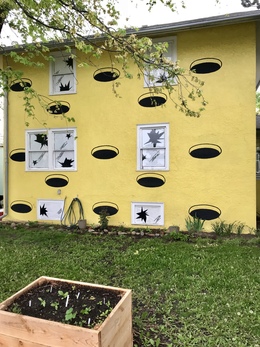
Using pavement, chalk, bouncy balls, and bean bags, artist Alberto Aguilar transforms the sidewalks surrounding the Madlener House into a floor game court and participatory performance. This event is designed as an outdoor program for children and families though participants of every age are invited to join.
This event is presented in collaboration with Cultural ReProducers in conjunction with the exhibition Estudio Tatiana Bilbao: Unravelling Modern Living.
Alberto Aguilar is a Chicago based artist. He has exhibited at the Museum of Contemporary Art Detroit; El Centro de Desarrollo de las Artes Visuales, Havana, Cuba; Palo Alto Art Center; National Museum of Mexican Art, Chicago, IL; Museum of Contemporary Art Chicago; Minneapolis Institute of Art: Crystal Bridges Museum of American Art, Bentonville, AR; and The Art Institute of Chicago. His work is held in the collections of the National Museum of Mexican Art; Crystal Bridges Museum of American Art; Soho House Chicago; and the Chicago Cultural Center. Aguilar is the recipient of the 3Arts Award.
Cultural ReProducers is an evolving group of active cultural workers—artists, designers, curators, musicians, performers, writers, etc.—who are also parents. Founded in 2012 by artist Christa Donner, the group is a creative platform, web resource, and community-based initiative that is for anyone interested in making the art world a more inclusive and interesting place by supporting arts professionals raising kids.
Image: Multiple Entires, latex paint and window signs on home, 2018.

 PREVIOUS POSTS