Influences: The Halprin Workshops
Chip Lord
Sep 25, 2014
(6pm)
Talk
Please RSVP
Chip Lord, cofounder of the experimental architecture collective Ant Farm, will reflect on his participation in one of the Halprins’ early collaborative workshops and the influence that this experience had on his later work.
Chip Lord was trained as an architect and was a founding member of the experimental art and architecture collective Ant Farm (1968-1978). Dedicated to finding alternatives to mainstream architectural practice, Ant Farm worked at the fringe of architecture, producing inflatable structures, organizing performances and media events, and exploring nomadic design. Ant Farm achieved widespread notoriety in the 1970s for such projects as House of the Century (1972), a ferro-cement weekend House in Texas, which won a Progressive Architecture Design Citation in 1971, and Cadillac Ranch (1974), an iconic work that is both public art and entropic sculpture and crosses disciplinary boundaries. Ant Farm also produced the video art classics Media Burn and The Eternal Frame, both in 1975. Following his involvement with Ant Farm, Lord continued to work in video and produced single channel tapes and installations, often collaborating with other artists. Lord has taught at the University of California, San Diego and the University of California, Santa Cruz, where he is Professor Emeritus in Film & Digital Media.
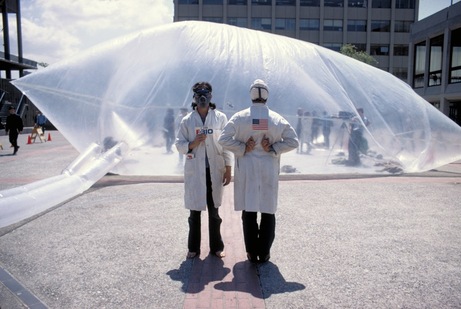
Image: The Clean Air Pod by Ant Farm at U.C. Berkeley on the first Earth Day, 1970. Courtesy Chip Lord.
For more information on the exhibition, Experiments in Environment: The Halprin Workshops, 1966-1971, click here.

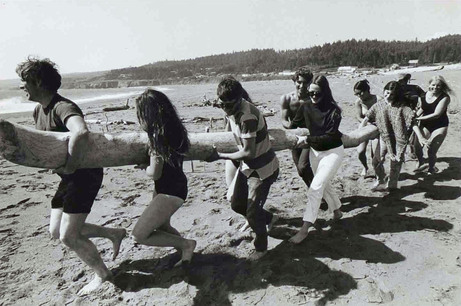
Courtesy of the Lawrence Halprin Collection, the Architectural Archives, University of Pennsylvania.
Opening Reception: Experiments in Environment: The Halprin Workshops, 1966-1971
Sep 19, 2014
(6pm)
Opening Reception
Please RSVP
Please joins us to celebrate the opening of our fall exhibition.
For more information on the exhibition, Experiments in Environment: The Halprin Workshops, 1966-1971, click here.
Archigram’s Los Angeles: A Sentimentality for the Future
Simon Sadler
Jul 21, 2014
(6pm)
Talk
Please RSVP
The images of Los Angeles by Britain’s Archigram group are a little perplexing. Are they depicting the Los Angeles of the 1960s, or a projected Los Angeles? On July 21, architectural and urban historian Simon Sadler delves into Archigram’s Los Angeles, a city that became the new locus of the urban imaginary in the vanguard circuits of 1960s London. Sadler considers how Archigram’s projections of a future Los Angeles were perhaps nostalgic for California’s recent past, while serving London’s larger fantasy of spontaneous, populist, self-organized urbanism.
Simon Sadler is professor of architectural and urban history at the University of California, Davis. His publications include Archigram: Architecture without Architecture (MIT Press, 2005); Non-Plan: Essays on Freedom, Participation and Change in Modern Architecture and Urbanism (Architectural Press, 2000, coeditor Jonathan Hughes); and The Situationist City (MIT Press, 1998). He currently coordinates the California section of the Society of Architectural Historians’ Archipedia project.
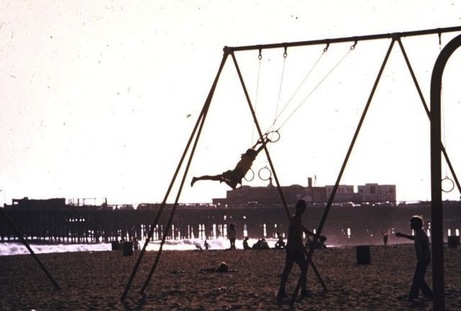
Image: Warren Chalk (Archigram), Santa Monica Beach, teaching slide, c. 1968.
For more information on the exhibition, Everything Loose Will Land, click here.
Curating Looseness
Jason Payne
Jul 16, 2014
(6pm)
Talk
Please RSVP
In conjunction with the Graham Foundation’s current exhibition, “Everything Loose Will Land,” curated by Sylvia Lavin, LA-based architect and designer Jason Payne will explore hybridity, chance, and “looseness,” and discuss how these concepts have informed his own experimental design work.
Jason Payne is associate professor of architecture at University of California Los Angeles and Principal of Hirsuta. He received his BArch from Southern California Institute of Architecture and his MS in Advanced Architectural Design from Columbia University. Prior to founding Hirsuta in 2008 he worked as project designer for Reiser + Umemoto/RUR Architects and Daniel Libeskind Studio and partnered on the award-winning office Gnuform. He has held teaching positions at Southern California Institute of Architecture, The Ohio State University, Rice University, Pratt Institute, Rensselaer Polytechnic Institute, and Bennington College.
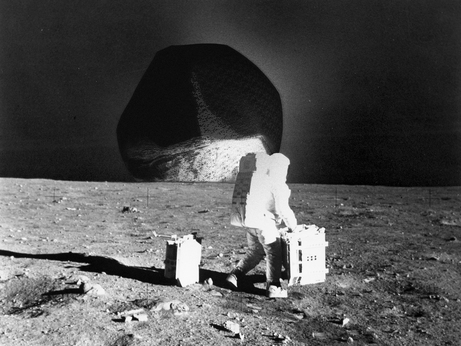
Image: Hirsuta (Jason Payne and Tim Callan), On The Turning Away, from Planetesimal Series II.
For more information on the exhibition, Everything Loose Will Land, click here.
Three Legged Race (Robert Beatty)
Jun 21, 2014
(8pm)
Performance
Please RSVP
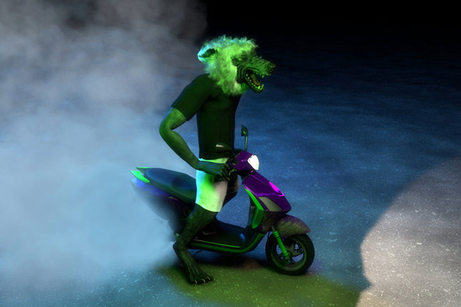
On June 21, American artist and electronic musician Three Legged Race (Robert Beatty) closes out Lampo's spring 2014 season with a performance and screening of new and recent work, as well as sound and video collaborations with artist Takeshi Murata, including the Chicago premiere of OM Rider and a new video piece commissioned by Lampo.
Robert Beatty is an artist and electronic musician who performs solo under the name Three Legged Race. He is a long-running member of the bands Hair Police, Eyes and Arms of Smoke, and C. Spencer Yeh's Burning Star Core. Through Beatty's collaboration with video artist Takeshi Murata, Three Legged Race has performed at the Ullens Center for Contemporary Art, Beijing, China; Deitch Projects, New York; the Mattress Factory, Pittsburgh; and the New Museum, New York. In 2013, Beatty released the acclaimed "Soundtracks for Takeshi Murata" (Glistening Examples), a collection of his audio work for Murata. Beatty's performances and recordings explore the repetition and decay of simple musical themes, evoking minimalist sci-fi soundtracks, clouded hypnotic landscapes, and primal industrial techno. He lives in Lexington, Kentucky.
This performance is presented in partnership with Lampo. Founded in 1997, Lampo is a non-profit organization for experimental music, sound art, and intermedia projects. Visit www.lampo.org.

 PREVIOUS POSTS