-
upcoming events
FORCE! an opera in three acts Anna Martine Whitehead Nov 12, 2026 Book Launch
Henry Fraser Lampo Performance Series Dec 05, 2026 Performance
-
past events
David Behrman & Cleek Schrey Lampo Performance Series Nov 07, 2026 Performance
Josephine’s Sharmyn Cruz Rivera and Daniel Giles Oct 16, 2026 Talk

Madlener House
4 West Burton Place
Chicago, Illinois 60610
Telephone: 312.787.4071
info@grahamfoundation.org
Code Words: Architecture, AI, the Linguistic (Re)Turn
Andrew Witt, Roberto Bottazzi, and Julian Besems
Dec 03, 2026
(6pm)
Talk
Free; RSVP required
In this talk, Graham Foundation grantee Andrew Witt, Roberto Bottazzi, and Julian Besems explore the evolving modes of linguistic discourse across design, history, and criticism as artificial intelligence reshapes the role of language in architecture:
“Language,” wrote architectural historian and theorist Adrian Forty, “allows architects to deal with everything that they find difficult, or choose not to be precise about—nuances, moods, atmosphere.” The words of competition briefs, theoretic ruminations, construction specifications, and polemic essays can be both rigorously precise and artfully ambivalent about this thing we have named architecture. Yet from Quatremère de Quincy’s claim that the monumental Egyptian hieroglyphics comprised “public libraries” to the postmodern “linguistic turn,” language acts as a singular creative medium. Today, large language models (LLMs), natural language processing, and generative text are mutating the contours of architectural language, opening new vistas and posing new challenges to architecture’s literate expression. By recentering linguistic expression as a wellspring of architectural understanding, creativity, and imagination, we can fully engage how language is taking on new potencies and possibilities in the age of artificial intelligence.
This event is presented in conjunction with a series of convenings on AI and language organized by the Bartlett School of Architecture, University College London; and Washington University in St. Louis.
Andrew Witt is a designer working across architecture, computation, and culture. He is the inaugural Kavita and Krishna Bharat Professor of Design and AI at Washington University in St. Louis, and cofounder of Certain Measures, a studio for trans-scalar design through data. With a background in both architecture and mathematics, he has a particular interest in a technically synthetic approach to form. The work of Certain Measures is in the permanent collection of the Centre Pompidou and has been exhibited at the Pompidou, the Barbican Centre, the Venice Biennale, the Museum of the Future, and the Canadian Centre for Architecture, among others. Witt is the author, most recently, of Formulations: Architecture, Mathematics, Culture (MIT Press, 2022).
Roberto Bottazzi is an architect, researcher, and educator based in London. He is an associate professor and director of the Master in Urban Design at the Bartlett, UCL. He is the author of Digital Architecture beyond Computers: Fragments of a Cultural History of Computational Design (Bloomsbury, 2018) and the upcoming Structures in the Void: The Architecture of Leonardo and Laura Mosso (Birkhäuser, 2026).
Julian Besems is a designer, researcher, and lecturer working across architecture and computation. He completed his doctorate at the Chair of Digital Architectonics, ETH Zurich. His research asks how architecture can engage the digital on its own terms, through computational experiments with language, images, film, and datasets that treat bias as a design tool. This agenda carries into his teaching as a design tutor for RC11 (MArch Urban Design) at the Bartlett, UCL, and in Media Studies at the Architectural Association.
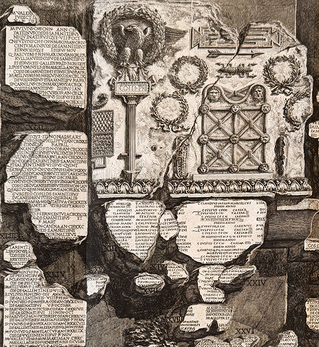
Image: Giovanni Battista Piranesi, “Lapides Capitolini, detail,” 1762. Etching of a multi-modal assemblage of historical spolia, images, and texts assembled into a new whole.

Unless otherwise noted,
all events take place at:
Madlener House4 West Burton Place, Chicago
GALLERY AND BOOKSHOP HOURS
Wednesday–Saturday, 12–5 p.m.
Free admission, no reservations required
CONTACT
312.787.4071
info@grahamfoundation.org
Accessibility
Events are held in the ballroom on the third floor which is only accessible by stairs.The first floor of the Madlener House is accessible via an outdoor lift. Please call 312.787.4071 to make arrangements.
Copyright © 2008–2026 Graham Foundation. All rights reserved.