2026
-
upcoming events
-
past events

Madlener House
4 West Burton Place
Chicago, Illinois 60610
Telephone: 312.787.4071
info@grahamfoundation.org
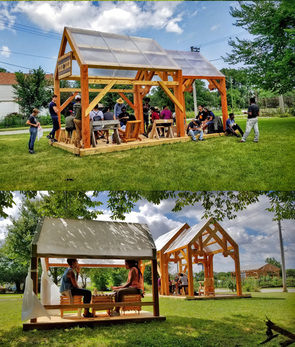
Join us for a talk by urban designer Emmanuel Pratt, recently named a 2019 MacArthur Fellow, as he discusses his approach to growing historically redlined neighborhoods through community-driven initiatives and shares current and upcoming projects.
Emmanuel Pratt is cofounder and executive director of the Sweet Water Foundation. His work explores architecture, urbanization, race, identity, gentrification, art and social praxis, and transformative processes of community economic development through intersections of food security and sustainable design innovation. He was a Loeb Fellow, Charles Moore Visiting Lecturer at Taubman College or Architecture and Urban Planning at the University of Michigan, and is currently a visiting lecturer for Environmental and Urban Studies at the University of Chicago.
Sweet Water Foundation practices regenerative neighborhood development, a creative social justice method, that creates safe and inspiring spaces by establishing healthy, intergenerational communities that transform the ecology of once-“blighted” neighborhoods. The Foundation utilizes a blend of urban agriculture, art, and education to transform vacant spaces and abandoned buildings into economically and ecologically productive and sustainable community assets that produce engaged youth, skilled workers, art, locally-grown food, and affordable housing. These principles are realized in the flagship Foundation project, the Perry Avenue Commons, encompassing approximately three acres on the South Side of Chicago.
Image: Re-Root + Redux, Perry Ave Commons, Sweet Water Foundation, Chicago, IL. Presented in conjunction with the 2019 Chicago Architecture Biennial.
For more information on the exhibition, Tatiana Bilbao Estudio: Unraveling Modern Living, click here.

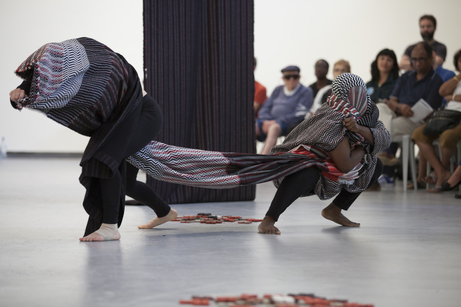
For an afternoon, the Graham Foundation will host an “open rehearsal jam” for Anna Martine Whitehead’s new project Force. Force is a dance opera about queer and trans women of color waiting to get into prison featuring an all qt+ bipoc cast and crew (qt+ = queer and/or trans and/or more; bipoc = black/brown/indigenous/person of color). Force’s open rehearsal will be an opportunity for anyone interested (regardless of background or ability to pick up an instrument) to move their body free from expectation. While this jam will be open to all, queer, trans, and gender nonconforming black, brown, and indigenous folks of color are especially encouraged to come through and take up space.
Anna Martine Whitehead does performance. She has been presented by venues including the Chicago Museum of Contemporary Art; San José Museum of Art; Velocity Dance Center; Chicago Cultural Center; Links Hall; AUNTS; and Yerba Buena Center for the Arts. She has developed her craft working closely with Onye Ozuzu, Jefferson Pinder, taisha paggett, Every house has a door, Keith Hennessy, BodyCartography Project, Julien Prévieux, Jesse Hewit, and the Prison + Neighborhood Art Project, among others. She has been recognized with awards from Portland Institute for Contemporary Art, The Graham Foundation, 3Arts, Chicago Dancemakers Forum, Foundation for Contemporary Arts, Headlands Center for the Arts, Rauschenberg Foundation, and Djerassi. Martine has written about blackness, queerness, and bodies in action for Art21 Magazine, C Magazine, frieze, Art Practical; and has contributed chapters to a range of publications including Queer Dance: Meanings and Makings (Oxford, 2017), Organize Your Own: The Politics and Poetics of Self-Determination Movements (Sobsercove, 2016), Platforms: Ten Years of Chances Dances (2016), and Girl Zines: Making Media, Doing Feminism (NYU, 2009). Martine is the author of TREASURE | My Black Rupture (Thread Makes Blanket, 2016).
Image: Anna Martine Whitehead performance at Hyde Park Art Center in collaboration with Jamie Hayes/Production Mode, 2017. Photo: Sarah Pooley
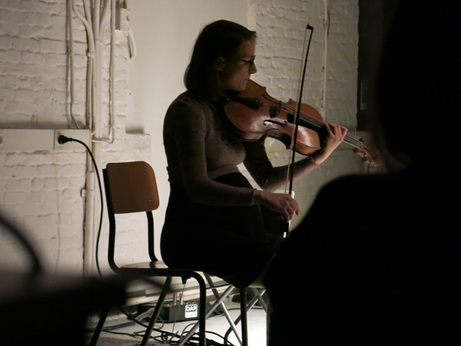
Catherine Lamb is a violist and composer who blends West Coast experimentalism with the structures and intonations of ancient Hindustani music. Her music reveals a slow-changing spectrum of microtonal colors and temporal effects, in stunning works that explore the interaction of sounds in specific physical spaces or rooms.
Lamb and frequent collaborator Rebecca Lane (bass flute/voice) will perform Prisma Interius IV with special guest Olivia Block. The piece is the fourth in a series of nine works constructed around the Secondary Rainbow Synthesizer, an instrument that spectrally filters live sound picked up from microphones outside.
“The intent is to extend the harmonic space and shapes occurring in the musical piece (defined by the acoustic instrumentalists in the room) to discover the edges of our listening perceptions, by pulling an infinite thread to it,” Lamb writes.
This is Lamb's Chicago debut and Lane's first U.S. performance.
Catherine Lamb is a composer and performer interested in how precise frequencies of pitch interact harmonically and sonically. She has been studying and composing music since a young age. In 2003 she turned away from the conservatory in an attempt to understand Hindustani classical music, later finding Mani Kaul in 2006. She also studied experimental composition at the California Institute of the Arts under James Tenney and Michael Pisaro, who were both integral influences. It was during this time that she began diving deeply into her own practice of what she later termed “the interaction of tone.”
Lamb is the co-founder of Singing by Numbers (2009-11), an experimental vocal ensemble formed with Laura Steenberge. She has written for ensembles such as Ensemble Dedalus, Konzert Minimal, the London Contemporary Orchestra, NeoN, Plus/Minus, and Yarn/Wire. Lamb is involved in ongoing research with Marc Sabat on intonation; with Johnny Chang on Viola Torros; develops work regularly with musicians such as Rebecca Lane, Dafne Vincente-Sandova, and Frank Reinecke; as well as taking part in Triangulum with Julia Holter and Laura Steenberge.
She is the recipient of an Emerging Composers Award from the Wallace Alexander Gerbode and William and Flora Hewlett Foundations for Dilations (2008-09); a travel grant from the Henry Cowell Foundation, allowing her to pursue work with Eliane Radigue (2012); a fellowship from Akademie Schloss Solitude (2016); was a Staubach Fellow at the International Summer Course for New Music in Darmstadt (2016); and received the Grants to Artists award from the Foundation for Contemporary Arts (2018). Her writings and recordings have been published by Another Timbre, Black Pollen Press, Kunst Musik, NEOS, Open Space Magazine, Q-O2, Sacred Realism, Sound American and Winds Measure. She graduated from CalArts in 2006 and received her MFA from Bard College in 2012. Lamb lives in Berlin, Germany.
Rebecca Lane is a Berlin-based musician who investigates sounds on the edge of perception, focusing on the experiential qualities of sound, but also on phenomena that only emerge through particular ways of working together. Thus, her practice is informed by ongoing collaborations with like-minded artists, including Catherine Lamb, Marc Sabat and Clara de Asís, among others, and within small ensembles, using various flutes (flute, quarter-tone bass flute, recorders) and voice.
Artist Talk: Ahead of her performance, Catherine Lamb presents a new performative lecture. In The Form of the Spiral, she draws something other than a straight line from artists like James Tenney and Maryanne Amacher, to things she has learned from Dhrupad, an ancient style of Hindustani classical music, making connections with her own recent work. Lampo Annex, Monadnock Building, 53 W. Jackson Blvd. #1656. Friday, December 13, 6pm. FREE; CLICK HERE TO RSVP VIA LAMPO
Supported by the Farny R. Wurlitzer Foundation Fund
Since 2010 the Graham Foundation has supported and partnered with Lampo to produce this performance series held at the Madlener House. Lampo, founded in 1997, is a non-profit organization for experimental music and intermedia projects.
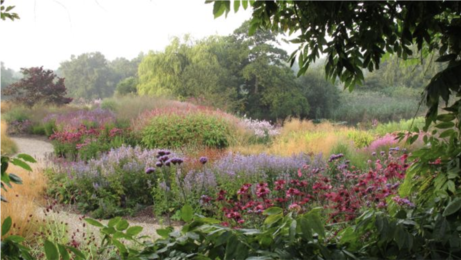
Join us for a screening of Five Seasons: The Gardens of Piet Oudolf, with an introduction by Laura Ekasetya, director and head horticulturalist of Chicago's Lurie Garden. Directed by Thomas Piper, the film immerses viewers in the work of Dutch garden designer Piet Oudolf, giving insight into his creative process from his abstract sketches, to theories on beauty, to the ecological implications of his ideas.
To watch the trailer, click here.
Laura Ekasetya is the director and head horticulturist at the Lurie Garden in Chicago’s Millennium Park where she works to maintain the integrity of Piet Oudolf’s perennial plant design. Laura enjoys stalking insects, birds, and other creatures that make the garden their home and is learning to identify the various birds that migrate through Chicago along the Mississippi Flyway. Laura has a bachelor’s degree in Psychology from Southern Illinois University Edwardsville and studied horticulture at Harold Washington City College of Chicago. Before joining the team at the Lurie Garden in 2017, she tended to perennials grown under research evaluation at the Chicago Botanic Garden.
Lurie Garden in Millennium Park combines naturalistic plantings and ecologically sensitive maintenance practices to create an urban oasis for city dwellers and wildlife alike. The garden offers a four-season experience and pays homage to Chicago’s transformation from flat marshland to a city heralded for investing in extensive green spaces, or “Urbs in Horto” (City in a Garden). Lurie Garden was designed by Gustafson Guthrie Nichol Ltd. and Dutch planting designer Piet Oudolf, and opened in 2004.
For more information on the exhibition, Tatiana Bilbao Estudio: Unraveling Modern Living, click here.
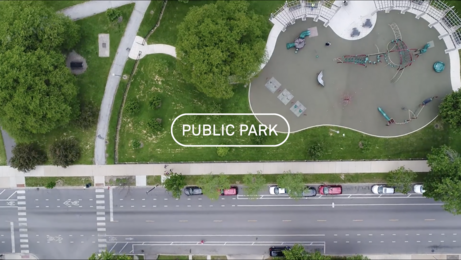
Considering the Chicago Park District network as a platform for cultural life and civic activation that is a unique network of public spaces, this participatory conversation raises questions about the significance, maintenance, and relevance of these civic spaces. With more than 600 parks, 400 field houses, 26 miles of lakefront, 50 outdoor pools, a museum campus, and Soldier Field, today’s Park District operates as a sovereign territory within the city. Multiple and distributed, this territory pervades every ward and neighborhood. Fieldwork asks local and global questions around “publicness”—the complex patterns of individuals and communities, and the systems that organize them. As a network of sites, each park is a polyvalent territory, at once natural, social, psychological, ecological, political, ethnic, historic, and economic. With cultural change, the distribution and structure of the park network faces new demands, and so does the very mythology that grounds it. If these parks were emblematic of Chicago as a city defined by modern industry, later additions to the system—such as Millennium Park—are emblematic of Chicago’s shift to finance, culture, tourism, and lifestyle economies.Through this discussion Fieldwork explores what opportunities emerge if we radically rethink Chicago’s parks.
Fieldwork Collaborative Projects is an interdisciplinary nonprofit dedicated to increasing cultural activity in the Chicago region. Established by artists with backgrounds in architecture, urban planning, anthropology, research, and criticism, the group has extensive experience with curatorial work and institutional administration. By working beyond the confines of the museum or gallery, Fieldwork transforms underutilized spaces traditionally used for sport or recreation by organizing performances, exhibitions, or other unexpected activities to expose the unseen, unconsidered, underestimated or overlooked potential of a particular place.
Nelly Agassi works in performance, installation, video, textile and paper. Her artwork addresses the idea of the body and notion of intimacy within public space in relation to architecture. Her work engages both the personal and emotional as well as universal concepts. Agassi is a 2001 graduate of the MA program of combined media in Chelsea College of Art and Design, London, UK. She has received the Nathan Gottesdiener Foundation for Israeli Art Prize and the Tel Aviv Museum of Art award for artistic encouragement from the Israel Ministry of Science, Culture and Sport. Agassi shown her work extensively throughout the world – in sites such as the Israel Museum, Doritto Rovesscio, Milan Triennial, Poor Farm, USA, Hyde Park Art Center, USA, Terrain Biannial, USA and at the Tate Modern in London.
Ionit Behar is an art historian, curator and critic. She is a Ph.D. candidate in Art History at the University of Illinois at Chicago. Her interests are focused on 20th century Latin American and North American art, the history of exhibitions, sculpture after 1960, and theories of space and place. Behar is interested in the relation between the academic discipline of art history and the practice of museum curating. She holds a Master’s degree in Art History, Theory and Criticism from the School of the Art Institute of Chicago, a Bachelor of Art Theory from Tel Aviv University, and a degree in Art Administration from the Bank Boston Foundation in Montevideo. She is the Curator of Collections and Exhibitions at Spertus Institute for Jewish Learning and Leadership and the Director of Curatorial Affairs for Fieldwork Collaborative Projects NFP (FIELDWORK).
Merav Argov is a graduate of the University of Illinois at Chicago (UIC) in the Urban Planning and Policy Department. She received her Bachelor of Fine Art degree in 1997 from Bezalel Academy of Art and Design, Jerusalem, Israel. She has participated in civic planning and programing in Jerusalem, Tel-Aviv, Jaffa, Amsterdam and Chicago, with insight into urban planning, art installations as well as programing and spatial enterprises. Along with art and environment planning and consultancy, she has worked at Bezalel Public Advocates in Jerusalem, and with the Arabic-Jewish organization for co-existence and democracy in Jaffa. Her works are shown at the Rosenthal Museum in Germany. Argov’s work dealing with the relation between people and their environment has been reviewed and featured in the Haaretz Magazine.
Andrew Schachman designs environments, infrastructures, and installations. He is the executive co-director of two organizations that are experimental spaces for delivering arts and culture within existing metropolitan networks: Floating Museum and Fieldwork Collaborative Projects. Trained as an architect, he designed and managed projects for the offices of Zaha Hadid, Perkins and Will, Carol Ross Barney, and Doug Garofalo. His projects have received numerous awards including the Distinguished Building Award from the American Institute of Architects and the Richard H. Driehaus Foundation Award for Architectural Excellence in Community Design. Principal of Studio Andrew Schachman, he recently completed the design for the Palais de Tokyo’s exhibition, “Singing Stones,” in the roundhouse of the DuSable Museum of African American History. Andrew is a Studio Associate Professor in the College of Architecture at the Illinois Institute of Technology.
For more information on the exhibition, Tatiana Bilbao Estudio: Unraveling Modern Living, click here.
GALLERY AND BOOKSHOP HOURS
Wednesday–Saturday, 12–5 p.m.
Free admission, no reservations required
CONTACT
312.787.4071
info@grahamfoundation.org
Copyright © 2008–2026 Graham Foundation. All rights reserved.
 PREVIOUS POSTS